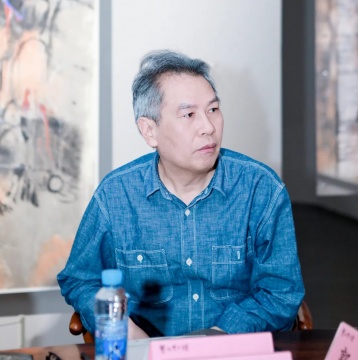
What is Heart Image Painting? What is the soul of painting? Today, Mogu Art Museum will take you to follow Professor Wang Duanting's article "The Interweaving of Emotion and Righteousness - The Character of Xu Shanxun's' Mind Image Painting '" and gain a deeper understanding of Xu Shanxun's paintings.
Wang Duanting, Chinese art critic, Western art historian, freelance writer, curator, independent art critic.
I have studied abroad at the University of Paris I in France (1997-1998) and the University of Rome I in Italy (2002-2003). Currently serving as the Director of the Foreign Art Research Office at the Institute of Fine Arts, China Academy of Art, Professor, Researcher, and Doctoral Supervisor at the Art Department of the Graduate School of China Academy of Art, Expert Committee Member of the National Contemporary Art Research Center, and Vice President of the Artists Association of the European and American Alumni Association.
情与意的交织 — 徐善循“心象绘画”的品格
The modern transformation of traditional Chinese art has been the common mission of several generations of Chinese artists over the past century. The collective concepts of artists from different generations and the individual choices of different artists have formed the evolution history of Chinese art over the past century. Due to the fact that the driving force behind the modernization of traditional Chinese art comes from the impact of Western civilization, and even the concept of modernity itself comes from the West, the integration of East and West has become a concrete manifestation and implementation approach for the modernization of traditional art. Essentially, the modernization of traditional Chinese art and the integration of Chinese and Western cultures are two dimensions that complement each other, namely, the modernization of traditional art is the temporal dimension of the integration of Chinese and Western cultures, and the integration of Chinese and Western cultures is the spatial dimension of the modernization of traditional art. These two dimensions form a horizontal and vertical coordinate system, in which every artist can find their position. This coordinate system is also the basis for art critics and historians to judge artists and their artistic value.
Xu Shanxun was born in 1960 and graduated from the Fine Arts Department of Northeast Normal University in 1982. He has been teaching at the university for 38 years since then. Like all artists of this generation who have received college education, Xu Shanxun's painting began with realism, and he even participated in a national art exhibition shortly after graduating from university. The establishment of art colleges in our country was transplanted from the West, and their teaching concepts, methods, and content also came from the West, that is, the perspective, sketching, and color teaching methods based on sketching and realism. This set of painting teaching and creation methods is completely different from the traditional Chinese painting brush and ink technique training method based on picture sheet. The most important thing is that Xu Shanxun caught up with the "85 New Wave Art Movement", which was an era of ideological turbulence and conceptual changes. From Expressionism, Surrealism to Abstract Art, Abstract Expressionism and other various formalist arts, from Dadaism, Pop Art to Installation Art, Performance Art and other conceptual arts, from Modernism to Postmodernism, all art styles of the 20th century in the West flooded into China's art scene simultaneously. As someone has said, Chinese artists in the 1980s completed the 100 year history of Western modern art in just ten years. It was during the "85 New Wave Art Movement" that Xu Shanxun resolutely abandoned the realism concepts and techniques of the academic school and passionately embraced modernist art.
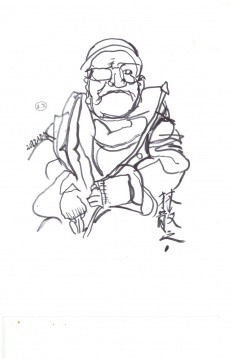
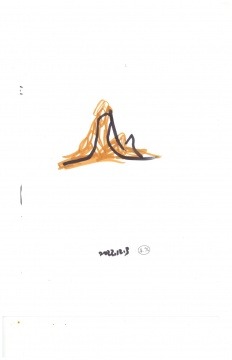
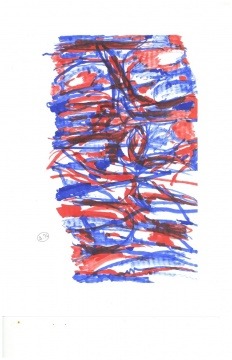
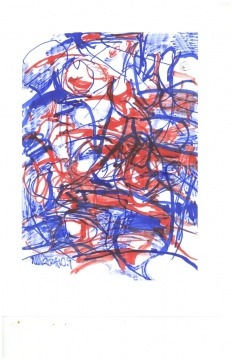
《速写》系列
Although the brush, ink wash, and rice paper are the most commonly used painting tools and materials by Xu Shanxun, and lines are his main means of shaping, with the help of these seemingly simple artistic media and language, Xu Shanxun is able to build a rich, colorful, and ever-changing art world. Xu Shanxun is a painter who keeps pace with the times and constantly seeks change. Before entering the abstract "mental image painting", his paintings underwent multiple transformations from subject matter to language. This transformation is presented in a series of creative forms, with the "Line Series", "Sketching Series", "Attachment Series", and "Soul Summoning Series" paving a clear path of transformation. However, these series are not completely separated from each other, and some of them overlap in time. That is to say, Xu Shanxun simultaneously created paintings of different themes and languages, and through in-depth research and steady development, he gradually advanced his path of painting innovation.
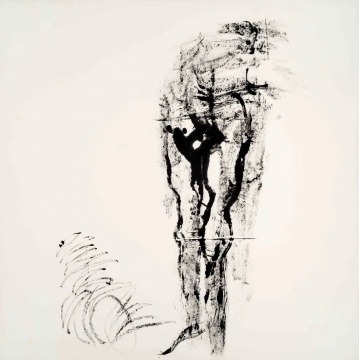
《线体系列》
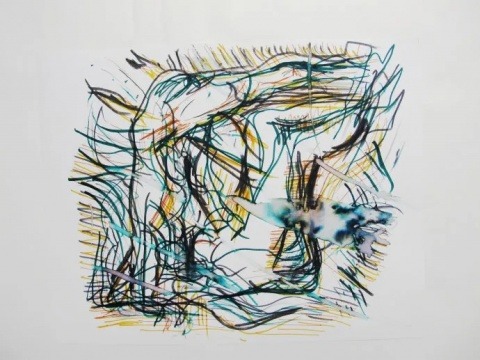
《速写系列》
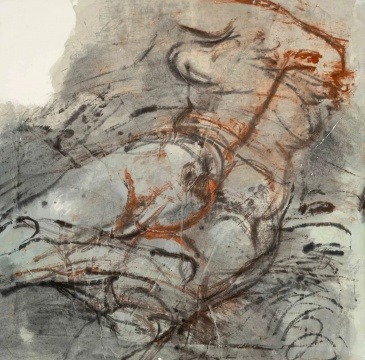
《附体系列》
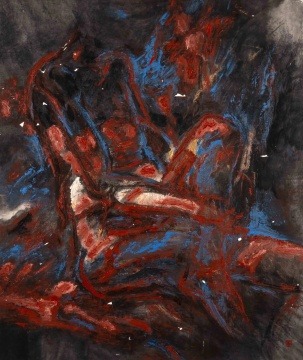
《招魂系列》
In Xu Shanxun's series of paintings, the painting work that he personally titled as "All Things in One", which overlapped the female body with the mountain, left a deep impression on me. The practice of overlapping two or more images on one screen is called the "transparency method". In my knowledge of art history, it was French Cubist and Dadaist artist Francis Picabia (1879-1953) who first used this technique to depict overlapping figures, animals, and plants. Later, another French painter named Raymond Georgein (1920-2005) used transparency to create a large number of fountain pen paintings featuring female portraits and human bodies, supplemented by various images such as text and musical instruments. He held a solo exhibition at the National Art Museum of China from May 5 to 17, 1987, which caused a sensation. I interviewed him as a reporter for China Art Daily at that time and published commentary articles for the newspaper. Later, I also wrote and published a book specifically for him titled "The Madness of Solo Wanderers - Raymond Raokeren's Painting Art" (published by Shanghai Literature and Art Publishing House in April 1996). Among Chinese painters, besides Xu Shanxun, there is also a Chinese American painter named Chen Yuanchu who has used this transparency method for oil painting and watercolor painting. Xu Shanxun was the first painter to apply the transparency method to ink painting, and his batch of "All Things in One" works using the transparency method are ingeniously conceived. By vividly overlapping the female body with the mountain range, the works present the symbolism of "unity of heaven and man" and "mother of the earth" in a visual and vivid way.
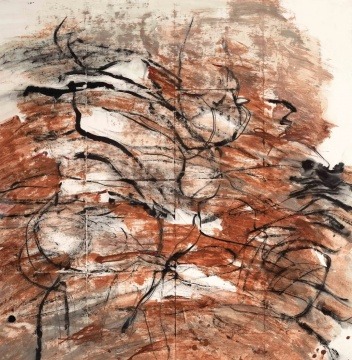
《万物一体》系列
Xu Shanxun's abstract painting did not emerge suddenly in a day, but went through an evolutionary process from concrete to semi concrete, and then to abstract. Although his paintings are all based on sketching, whether it's landscapes or characters, his sketching is not a reproduction of reality, but a refinement of reality. In the process of constantly simplifying natural objects, his paintings naturally entered the abstract world. In other words, his abstract painting is not a product imposed by external factors, but a spontaneous fruit on his own artistic tree, which also conforms to the logic and laws of the emergence of abstract painting.
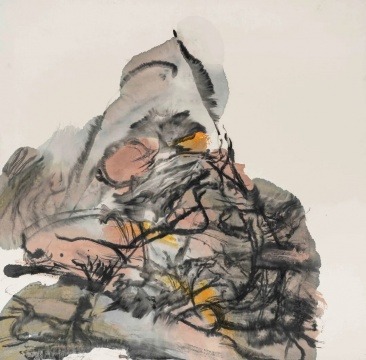
《万物一体》系列
Xu Shanxun named his abstract paintings the "Hongmeng Series", which began in 2023. After more than a decade of refinement, this type of creation has reached maturity. 'Grass and Grass Grey Line' is a material and form invented by Xu Shanxun for creating abstract paintings. Through this unique material and form, he created a novel and unique style of abstract painting. Black and white lines are still the backbone of this type of abstract painting, and as the background or base of the painting, Xu Shanxun uses various techniques including ink blending, oil painting thick coating, and acrylic dripping to create a surreal atmosphere of the vast universe and the unfathomable mystery.
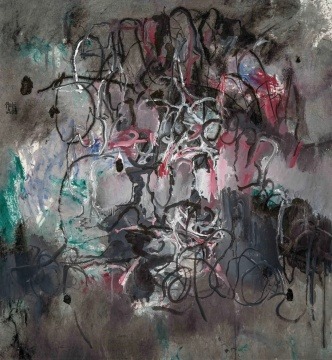
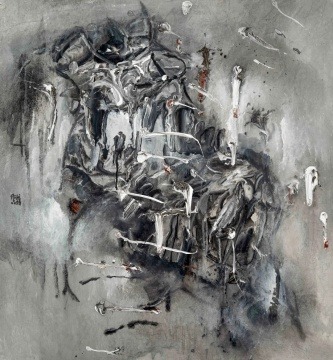
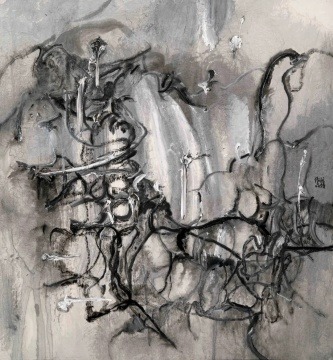
《草木灰线》系列
'Heart Image Painting' is a nickname given by Xu Shanxun to his abstract paintings, which is highly in line with his abstract painting nature. As early as more than a decade ago, I used the concepts of "mental imagery" and "intellectual imagery" to respectively explain the two opposing and interdependent types of "lyrical abstraction" and "geometric abstraction" in Western modern abstract painting. I pointed out that the former comes from the painter's heart and acts on the audience's heart, that is to say, the "lyrical abstraction" based on psychology is related to the expression and resonance of human emotions such as joy, anger, sorrow, and happiness; The latter comes from the painter's brain and is beneficial for enhancing the audience's intelligence. In other words, "geometric abstraction" based on mathematics aims to reveal the inherent laws and order of all things in the universe. However, in terms of Xu Shanxun's abstract paintings, the "mental image" here is not just about "expressing emotions", but also carries the element of "freehand brushwork". We know that in the process of translating from Chinese to English, scholars from both China and the West usually translate Chinese "freehand brushwork" into English "expression". As an abstract painter in China, Xu Shanxun's "mental image painting" is precisely the product of the combination of "lyricism" and "freehand brushwork".
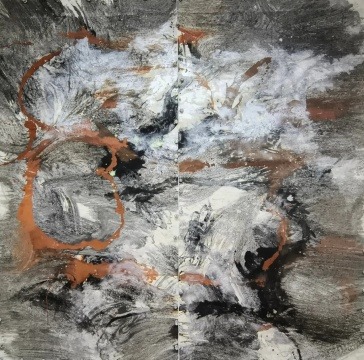
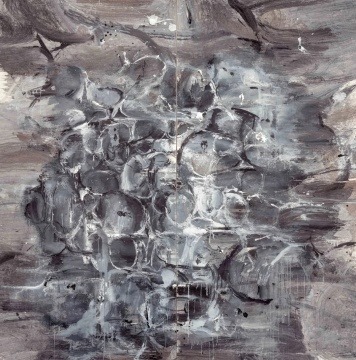
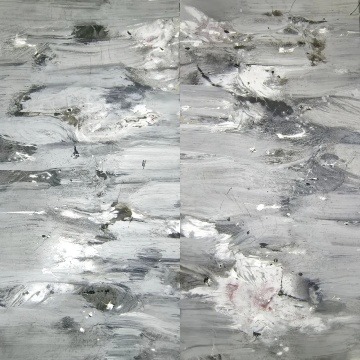
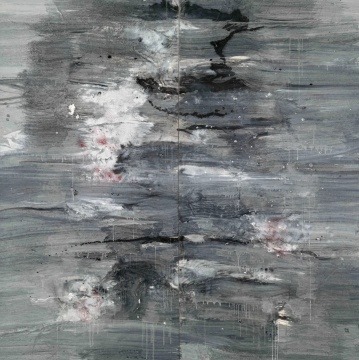
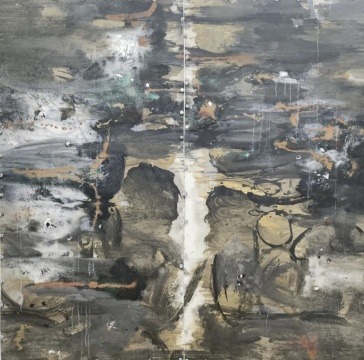
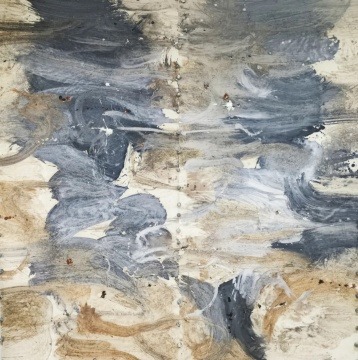
《鸿蒙》系列
This is also a significant feature that sets the works of many Chinese abstract painters, including Xu Shanxun's "Mind Image Painting," apart from Western "lyrical abstract" painting. What is' lyricism '? Lyrics is the expression of an artist's inner emotions. What is' freehand brushwork '? Freehand painting is the expression of an artist's wishes. By examining Xu Shanxun's "Hongmeng Series" paintings, we can clearly distinguish the constituent factors and effects of "lyricism" and "freehand brushwork". From the smooth or stagnant lines in Xu Shanxun's paintings, as well as the use of different colors such as black, white, gray, red, yellow, and blue, one can see his emotional state of comfort or depression when creating this work; The richly layered space and deep and vast artistic conception in the painting undoubtedly express his desire to transcend the mundane world and pursue lofty goals. Although "freehand brushwork" weakens "lyricism" and makes Xu Shanxun's "mental imagery painting" less intense in expressing emotions than Western lyrical abstraction, especially abstract expressionist painting, it gives his works a more enduring and intriguing charm than Western lyrical abstraction painting. For Xu Shanxun, the integration of Chinese and Western elements is not just a concept, but is specifically reflected in the depiction of every line, the use of every color, and the arrangement of the entire picture structure layout, as well as the interweaving and careful configuration of emotions and meanings. Through years of dedicated pursuit, Xu Shanxun has built a spiritual utopia for the world to express emotions and place the soul.
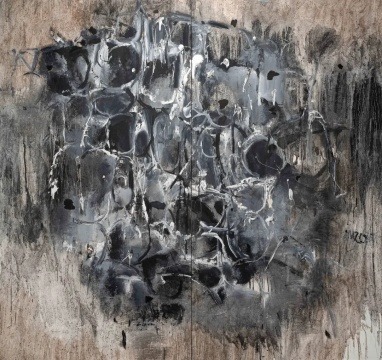
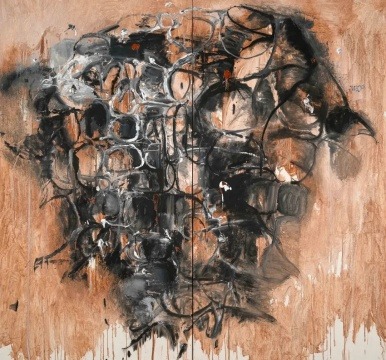
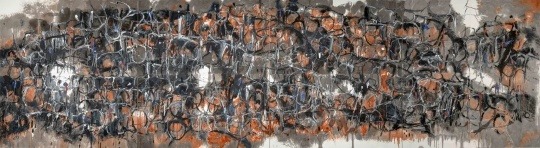
《众生结界》系列
From realism to abstraction is the limit of artistic breadth that a painter can cross, and Xu Shanxun has successfully accomplished this leap. For him, the remaining goal is to constantly explore the depth of art, because the human heart is like the universe, infinitely deep, and requires artists to explore endlessly.