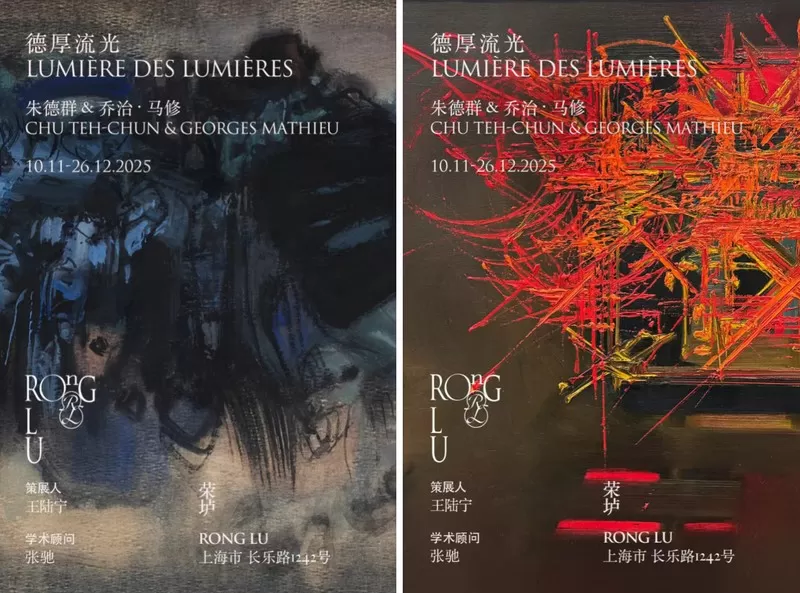
Rong Dong RONG LU is pleased to present the "Lumi è re des Lumi è res" exhibition featuring Zhu Dequn and George Mathieu, two 20th century art giants - Chu Teh Chun, a Chinese artist living in France, and Georges Mathieu, a pioneer of French lyrical abstraction. The exhibition selects representative works created by the two artists in the 1960s and 1970s, presenting their lyrical and abstract artistic dialogue and mutual resonance through the theme of "Lumi è re".
The exhibition title "Lumi è re des Lumi è res" combines the dual connotations of "light" and "enlightenment of wisdom" in French - "lumi è re" means light, while "lumi è res" implies enlightenment of wisdom and reason, which perfectly echoes the creative characteristics of the two artists.
The theme of "light" is perfectly presented in multiple dimensions in the works of the two artists, and is also contrasted with Rongdang Space itself as a "container of light". In Zhu Dequn's works, the interweaving of color blocks and lines, the dialogue between light and shade and warmth, and the birth and evolution of light into floating halos in the frame; And George Matthew creates a strong contrast through extended lines and rushing colors, like a dazzling beam of light. Their artistic practice is not only a breakthrough in form, but also a fusion of Eastern and Western ideas, jointly opening up the direction for the development of art in the second half of the 20th century.
From Hangzhou to Paris: Zhu Dequn's Road of Chinese Western Co governance
Zhu Dequn was born in Hangzhou in 1935. At the age of fifteen, he was admitted to the National Hangzhou Art College and began studying traditional painting by the West Lake, exploring the possibilities of painting. Despite his achievements in Taiwan, he still chose to go to Paris to pursue new artistic breakthroughs. In 1955, he arrived in Paris and embarked on the path of abstract art research in an atmosphere of artistic freedom. Inspired by Western abstract art, Zhu Dequn broke away from figurative painting and captured the "spontaneity in control", achieving a leap and transformation in artistic language.
Zhu Dequn's artistic language is rooted in Eastern landscapes and calligraphy, and has transformed into modern lyrical abstraction in the artistic atmosphere of Paris. He emphasized that 'interpreting nature in the heart', and the image is not a reproduction of external scenery, but an externalization of inner spirit. His work "Composition No. 248" showcases the fusion of Eastern calligraphy and Western abstract expressionism, while his 1996 ink wash work "Untitled" embodies the tension of improvisation and balance, serving as a model of the combination of Chinese and Western artistic spirits.
From West to East: George Matthew's Innovation in Performance Painting
In the mid-20th century, abstractionism sprouted in Schengen, Europe and America, and self-taught artist George Matthews took a pioneering role in contemporary artistic innovation and played a pivotal role. Matthew's paintings are characterized by fast-paced and explosive lines. He often uses a long pen to paint, and even squeezes paint directly onto the canvas through the nozzle. These real-time actions and efficient execution result in a strong sense of contingency, energy, and freedom in the visuals. In 1947, French critic Jean Jos é Marchand first used the term "lyrical abstraction" to describe Matthew's artistic creations, making him the founder of this genre.
In 1956, George Matthew published an article titled "Raports de determinins aspects de la peiture non figurative lyrique et de la calligraphie chinoise" to document his endless contemplation of the East. In 1957, Matthew arrived in Japan for the first time and extracted non symbolic forms of writing expression from calligraphy. His brushstrokes were free and unrestrained, and the form of live painting in front of the audience was extremely avant-garde. The contrasting colors, heavy pigment texture, and strong physical interpretation formed Matthew's unique artistic language of combining human and painting. The work 'Excideuil' in this exhibition is set in deep tones, with a central interweaving of swift and decisive brushstrokes, like an instant burst of energy solidifying on the canvas.
This exhibition focuses on the 1960s and 1970s - the "golden age" when one or two artists were both mature in their creations and valued in the market. Through the multidimensional interpretation of the theme of "light", it redefines the dual status of classic works in academia and the market. Zhu Dequn's works blend the rhythm of Chinese calligraphy with Western abstract expression, while George Matthew's works witness a deep dialogue between European lyrical abstraction and American abstract expressionism. The exhibition showcases classic works from the mid-20th century and emphasizes that these works are not only important components of art history, but also valuable assets in the current art market.
The artistic value of Zhu Dequn and George Matthew is still being discovered, and in recent years, they have also regained high attention in the international art world. In 2024, the Fondazioni Giorgio Cini in Venice will hold a large-scale retrospective exhibition. In 2025, Matthew's exhibition at the Monnaie de Paris in Paris received widespread attention, further proving the important position of the two artists in the international art world.
部分展出作品:
朱德群《构图第 248 号》,1965 纸上水粉 38 x 53 cm 51.5 x 67 x 4 cm (带框)©图片致谢 Waddington Custot
乔治·马修 Cuscule, 1978 布面油画 73 x 92 cm77.7 x 96,2 cm (with frame) ©Comité Georges Mathieu / ADAGP, Paris, 2025. 图片提供:艺术家遗产与贝浩登