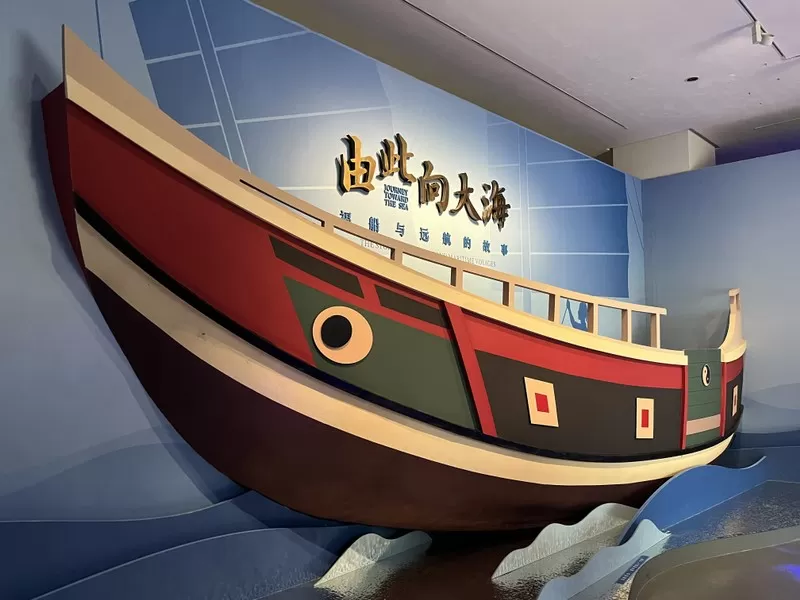
The ocean is an important channel for humans to understand the world and connect distant places. From coastal navigation to ocean exploration, the Chinese people's understanding and practice of the ocean have gone through a long process of development. On June 5th, the special exhibition "From Here to the Sea - The Story of Lucky Ships and Distant Voyages" hosted by the Changsha Municipal Bureau of Culture, Tourism, Radio and Television and organized by the Changsha Museum and the Quanzhou Overseas Transportation History Museum officially kicked off in the Special Exhibition Hall 2 of the Changsha Museum.

This exhibition takes Fuchuan as the clue and is divided into four units: "Ship Starting Southeast", "Maritime Trade", "Sailing for Thousands of Miles", and "Human Sea Dependence". It comprehensively sorts out ancient Chinese shipbuilding techniques, maritime trade, ocean exploration, and maritime cultural features, vividly reproducing the millennium long history of the Chinese nation's "birth to the sea" and showcasing the sustained and profound interactive relationship between Chinese people and the ocean.
普通水手“阿勉”的一生
Entering the exhibition hall, a wooden sailboat with eyes came in front of me.

As the curator of this exhibition, Chen Zihui, a young curator at Changsha Museum, introduced that the exhibition takes Fu Chuan as the entry point and presents the historical process of Chinese people's understanding of the ocean and their journey towards distant places through multiple dimensions such as ship technology, navigation practice, maritime trade, and social life. This is also the core curatorial idea of the exhibition.
The exhibition theme contains three layers of profound meaning, connecting the Chinese people's exploration of the ocean: firstly, the inheritance of shipbuilding technology, showcasing the millennium evolution of Chinese shipbuilding technology, from canoes and wooden boats to mature types of sea vessels represented by Fuchuan, which is the technological foundation for long-distance voyages; The second is the expansion of maritime routes. Through long-term practice, sailors have gained an understanding of the ocean and explored shipping routes, gradually opening up the Maritime Silk Road that connects China with the world. It is not a single route, but a maritime network formed by countless navigators constantly exploring and interweaving, which is an extension of the maritime space; The third is the continuation of the spirit of navigation. Generation after generation of sailors passed on the torch, ultimately forging the civilization process of Chinese people 'born to the sea'.

明代水手“阿勉”和他的“航海小册子”
福船上的船眼与十二生肖
The first unit, 'Ship Rises Southeast', first reveals the mysterious veil of the lucky ship.

As one of the three major wooden sailing ships in ancient China, Fuchuan refers to the ocean going ships built in Fujian. They gradually took shape based on the complex marine environment along the coast of Fujian, adopting a pointed bottom and wide surface design. The hull is V-shaped and has a deep draft, possessing strong wave breaking ability. The term 'Fuchuan' was officially named in the Ming Dynasty, initially referring specifically to naval warships, and later gradually became a general term for Fujian's long-distance wooden sailing ships.

福船上的对联
The exhibition hall uses cross-sectional and longitudinal models of the ship's hull to visually display the iconic structure of the Fuzhou Ship's watertight compartments. The design of independent compartments can effectively avoid the risk of ship leakage and greatly improve navigation safety. The eye drawn on the bow of the ship is a typical decoration of a lucky boat, with the fishing boat eye facing upwards and the merchant ship eye facing forward, symbolizing the beautiful wishes of sailors for safe and distant voyages.

用来升降船帆的“猴头”
There are a large number of elements of the twelve zodiac signs reflected on the lucky boat. The eyes of a ship are called "dragon eyes" and are located on both sides of the bow. The toilet area at the stern of the ship is called the "rabbit toilet" - because "rabbit" sounds similar to "spit", the toilet panel is located here. The twelve zodiac signs are not only symbols of decoration and auspiciousness, but also have practical functions. Many ancient shipbuilders were illiterate, and they memorized the structure of the ship's hull through the mnemonic of the twelve zodiac animals, which facilitated communication and construction. For example, the pulley for lifting a sail is called a "monkey head" because it is as flexible as a monkey.

左为堪舆罗盘,右为航海罗盘

量天尺 (复制品)
Due to the long-term immersion of wooden sea vessels in seawater, they suffer from significant damage and are extremely difficult to preserve. There are very few intact ancient ships in existence, most of which are underwater sunken remains. Therefore, the exhibits in this unit mainly consist of ship models, replicas, and traditional shipbuilding tools, while also showcasing river boat models made by local craftsmen in Changsha to compare and distinguish the differences in shape between pointed bottomed sea boats and flat bottomed river boats. In addition, the exhibition hall also systematically displays the evolution of navigation tools from Sinan and Shuifang compasses to navigation compasses, as well as astronomical navigation equipment such as star pulling boards and measuring rulers, and exhibits folk compass books to restore the complete ancient navigation technology system.

国内唯一经考古发现的海外返航木帆船
The second unit, "Sea and Land Trade," focuses on the core role of ships in ancient maritime trade.

The Song Dynasty sea vessel unearthed in Quanzhou Bay in 1974 is the most important archaeological evidence in this unit. This sunken ship is currently the only ancient ocean going wooden sailing ship in China that has been discovered through archaeological research and has returned from overseas. More than 500 copper coins, wooden tags used for cargo identification, and a large amount of spice wood such as agarwood, sandalwood, and agarwood have been unearthed inside the ship. The total weight of the spices in the un dehydrated state is more than 4700 pounds, which proves that this is a fully loaded ocean going spice ship. The remaining parts of the sunken ship have fully preserved the classic structure of the pointed bottom, wide surface, and watertight compartments of the Fu Ship, providing valuable physical evidence for the study of Song Dynasty Fu Ship technology and maritime trade. The exhibition hall also displays ship models reconstructed based on archaeological data.

拓印的钱币

木牌签

香料
The economic center of the Song Dynasty shifted southward, coastal ports developed rapidly, shipbuilding technology improved significantly, and maritime commerce reached its peak. As a result, Fuchuan became the main ship for maritime trade. Ancient maritime merchants used lucky ships to export domestic goods such as porcelain and silk overseas, and also transported exotic products such as spices and treasures back, building a maritime trade channel for mutual exchange.

长沙窑展示

郑和下西洋团队中也有湖南人
The third unit "Setting Sails for Thousands of Miles" focuses on the epic oceanic feat of Zheng He's voyages to the West during the Ming Dynasty. The exhibition hall is centered around Zheng He's treasure ship, accompanied by various ship models, to recreate the spectacular scene of the fleet's grand expedition. The Zheng He fleet was unprecedentedly large, with large treasure ships as the command flagship, paired with various types of ships such as grain ships, warships, and supply ships, forming a fully functional ocean fleet. The number of accompanying personnel each time they went out to sea may reach about 27000.

Zheng He, originally named Ma Sanbao, was given the surname Zheng due to his repeated military achievements. Influenced by his family's tradition of long-distance voyages, he was appointed as the envoy to the Western Seas. According to historical records, Zheng He's fleet consisted of over 200 ships, each responsible for cargo transportation, escort, logistics, and other functions. In order to resist the wind and waves at sea, Zheng He used mostly Fu boats during his voyages to the West, among which the most important large Fu boats, also known as "treasure boats", were responsible for transporting envoys from various countries, as well as shipping gifts and trade goods. Zheng He, the deputy commander of the fleet, once sailed on a giant ship with 5000 materials.
《郑和航海图》(钱松喦作) 泉州海外交通史博物馆藏
原名《自宝船厂开船从龙江关出水直抵外国诸番图》,后人简称为《郑和航海图》。该图是郑和下西洋航路的真实记录,约成于洪熙元年(1425)至宣德五年(1430)间。原图今已不存,现存版本主要依赖明末茅元仪所编《武备志》收录。此作为新金陵画派领军人物钱松喦(1899-1985)绘制。
The exhibition hall displays Zheng He's navigation map drawn by Qian Songgui, which includes annotations of various places such as Guli and Hulumus, visually reflecting the long voyage of the fleet. There are also exhibits such as Zheng He's image stele and stele extension, which restore relevant historical details from multiple angles. The unique Mazu belief of Fuchuan also continues in the fleet. Zheng He himself also revered Mazu. During the Ming Dynasty, two imperial edicts were granted to Mazu, one of which was facilitated by Zheng He.。

Chen Zihui emphasized that Zheng He's voyages to the West were not a personal act, but a grand voyage led by the state, relying on the accumulation of shipbuilding technology, the inheritance of maritime experience, and the relay of coastal sailors from generation to generation.
For a long time, the deeds of the vast majority of accompanying crew members, except for Zheng He, have been little known and only sporadically recorded in inscriptions, epitaphs, and personal notes. In recent years, scholars have excavated a large amount of new historical materials from the "Selected Records of Military Positions in the Ming Dynasty", bringing these long-distance travelers back to the public eye. This exhibition displays a list of 169 officers from the Western Expedition Guard, who came from all over the world, some died of illness in foreign lands, and some went to sea multiple times to make contributions, jointly supporting this great voyage. Among them, the record of Li Tianbao, a native of Chaling, Changsha, who "went on business trips to the West and other places for ten years" has brought this history closer to local audiences.

名册中记录了部分跟随郑和下西洋的人员名单
Far voyages have brought about profound cultural exchanges between China and foreign countries. The Monument to the Divine Response of the Heavenly Concubine "records that after the fleet arrived in various overseas countries, rare and exotic animals such as lions and leopards were presented locally. The giraffe introduced from overseas was also regarded as a traditional divine beast" qilin "by ancient people, which changed the Chinese people's understanding of divine beasts. Zheng He's translator Fei Xin also recorded in his travelogue that Java was rich in overseas delicacies such as clams. To this day, in Indonesia, India, and other places visited by Zheng He, relics such as the Sanbao Temple and Sanbao Cave still exist, and traditional Chinese ship plate sealing techniques are also passed down locally, witnessing the long-term integration of transoceanic civilizations.

展览现场
航海背后的人生百态
This exhibition does not stop at telling the story of Fu Chuan, but extends the perspective to the ordinary people behind the long voyage. Sailors and shipbuilders on long voyages, as well as people engaged in trade, shipping, and daily livelihoods in coastal settlements These people together form the foundation of social development along the southeast coast. The fourth unit "Human Sea Dependence" returns to the essence of human beings, showcasing the vibrant life and social support behind navigation.

象棋(复制品)
The maritime life of ancient sailors was not just about heavy labor. The exhibition hall relies on replicas of cultural relics from the Quanzhou shipwreck in the Song Dynasty to restore the daily lives of sailors: replicas of chess pieces confirm that sailors used playing games to pass their leisure time, and fragments of printed materials unearthed from the shipwreck prove that sailors had a habit of reading; Small porcelain vases may serve as crew drinking utensils, and the unearthed remains of animal bones, cooking utensils, weapons, and other items fully demonstrate the crew's daily life and maritime activities.

造船工具展示
The smooth sailing time and time again cannot be separated from the comprehensive support of the land society. Fuchuan is mainly built using pine wood from Fujian's mountains and forests, forming a complete industrial chain from logging materials, shipbuilding and ship repair to material supply. The exhibition hall displays multiple traditional shipbuilding tools. Although these ordinary folk tools are not rare cultural relics, they are the most authentic record carriers of maritime civilization.

福建地区女性服饰展示
In the era when a large number of men set sail, women along the coast of Fujian became the main force of onshore labor. The traditional clothing exhibited in the exhibition hall is highly ingenious: the short top design avoids being hooked during labor, the loose pants legs can be tightly tied and waterproof, and the matching bamboo hat and headscarf have windproof, sun protection, and warmth functions. Behind practical clothing lies the figure of coastal women silently cultivating and supporting the entire marine society. They are an indispensable and important force in the development of marine civilization.

髹朱漆描金镂雕柳树渔船图木花板,长沙博物馆藏
This exhibition displays a total of 162 pieces (sets) of exhibits, with the vast majority of cultural relics being replicas or ordinary shipbuilding tools, except for ship models. Unlike the commonly seen "treasure type" exhibitions, the cultural relics in this exhibition are more from daily life. The exhibition concludes with two wooden flower boards from the collection of Changsha Museum. Although inland areas may seem distant from ocean navigation, elements of ocean and water town culture such as boat patterns, fishing, woodcutting, farming, and reading have already been integrated into artifacts, art, and daily life, subtly influencing future generations.